
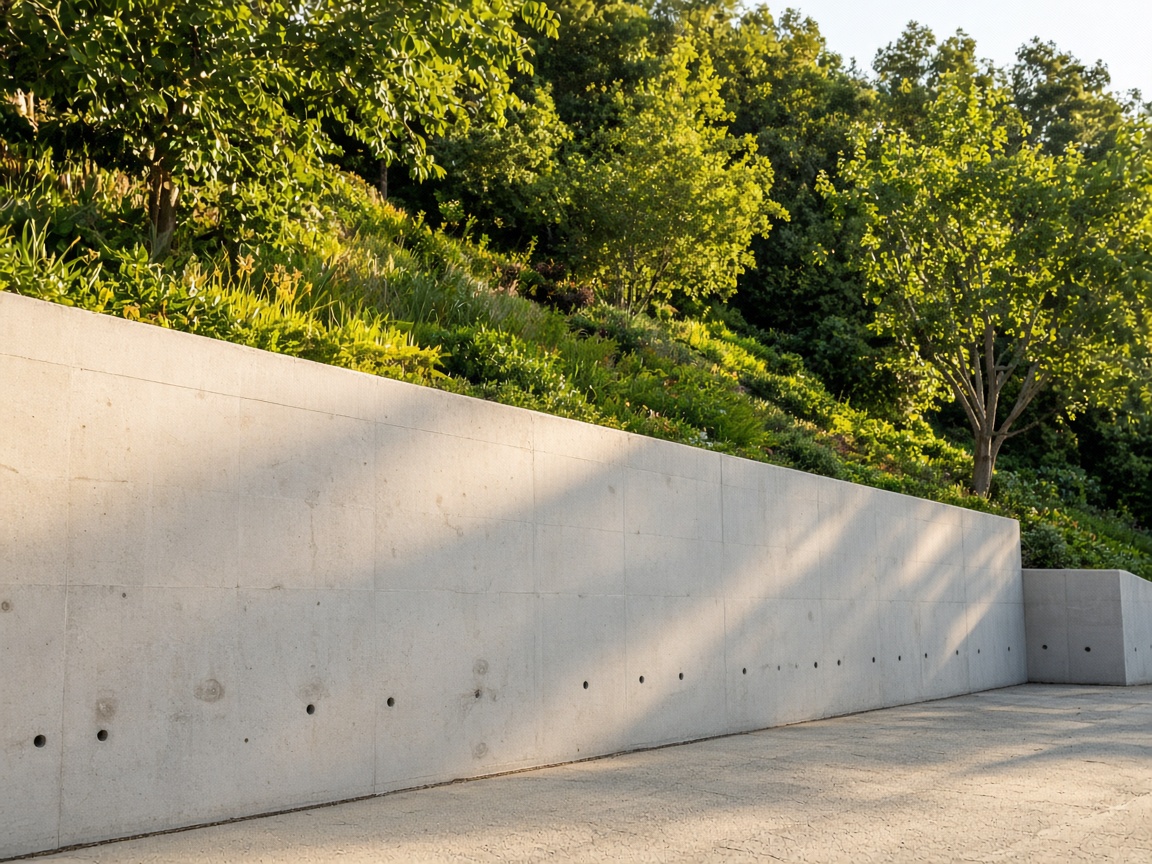
Concrete Retaining Walls San Jose
Poured concrete and concrete block retaining walls built for maximum strength. Ideal for high-load applications, tall walls, and tiered hillside lots.
What We Handle
- Poured concrete and concrete block (CMU) options
- Reinforced with rebar for maximum structural strength
- Smooth, board-formed, or exposed aggregate finishes available
- Engineered for walls taller than 6 feet
- Ideal for hillside lots, commercial sites, and high surcharge applications
When the load is heavy, the slope is steep, and longevity matters, poured concrete or concrete masonry unit (CMU) walls are the gold standard. Concrete compatibility with steel reinforcement and its ability to be formed into almost any shape make it the material of choice for walls that need to perform under serious conditions.
Poured Concrete Walls vs. Concrete Block (CMU) Walls
Poured concrete walls involve setting wood or metal forms, placing rebar in a predetermined pattern, and pouring concrete to create a monolithic wall structure. The result is a wall with no joints that is uniform in composition throughout its depth. Poured walls excel at heights over 8 feet and in situations where the wall needs to cantilever from a large concrete footing — the footing and wall are poured as a single integral structure, which is the most structurally efficient configuration for heavy loads.
Concrete masonry unit (CMU) block walls are built using concrete block units laid in a running bond pattern with mortar joints, and reinforced vertically with rebar grouted in the block cores. CMU walls are faster to construct than poured walls, require less formwork, and are somewhat easier to modify or repair. They are a popular choice for walls in the 4 to 10 foot range.
Finish Options for Concrete Retaining Walls
Poured concrete walls can be formed against smooth plywood for a flat finish, rough-sawn boards for a wood-texture look, or architectural form liners for decorative patterns. Exposed aggregate finishes created by surface washing after pour curing are popular in San Jose's residential market for their natural, stone-like appearance.
CMU walls can be left as natural grey block, finished with a cementitious stucco, or painted. Split-face block units create a rough, stone-like texture directly from the block mold. Both poured and CMU walls can be painted or coated with elastomeric waterproof paint to enhance weather resistance.
Engineering Concrete Walls for San Jose's Conditions
San Jose and Santa Clara County are in Seismic Design Category D under ASCE 7 — which means concrete retaining walls here need to be engineered with seismic forces in mind. The Hayward Fault and Calaveras Fault are both capable of producing magnitude 6.5+ earthquakes within shaking distance of most San Jose properties. An engineered retaining wall built to California Building Code accounts for this lateral loading, which changes the rebar schedule, footing width, and wall thickness requirements.
The expansive clay soils common in the Santa Clara Valley also demand careful attention to drainage behind concrete walls. Because concrete walls are impermeable, all water drainage must happen through weep holes in the wall face or through a perimeter drain pipe at the footing level. Without this, hydrostatic pressure can build to extraordinary levels — calculations for fully saturated soil behind a 6-foot concrete wall produce lateral forces that exceed what most homeowners would expect.
Common Questions
How thick does a poured concrete retaining wall need to be?
For cantilever concrete walls, thickness is engineered based on wall height and soil load. A 6-foot wall typically has a stem 8 to 12 inches thick. A 10-foot wall may require 12 to 16 inches. Your engineer will specify this based on your site conditions.
Do concrete retaining walls need weep holes?
Yes, always. Weep holes (typically 2-inch PVC pipe) are placed at 6 to 8 foot intervals near the base of the wall to allow hydrostatic pressure to relieve. They are used in addition to, not instead of, a gravel drainage layer and drain pipe behind the wall.
How long does a poured concrete retaining wall last?
A properly designed and constructed poured concrete retaining wall has a service life of 75 to 100+ years. The concrete itself is extremely durable; the limiting factors are typically drainage system maintenance and any structural cracking from seismic movement or settlement.
Ready to move forward with your concrete walls project? San Jose Retaining Wall Co handles retaining wall work across San Jose and Santa Clara County. Call us or fill out the quote form and we'll be in touch quickly.
Get a Free Quote
Other Wall Services