
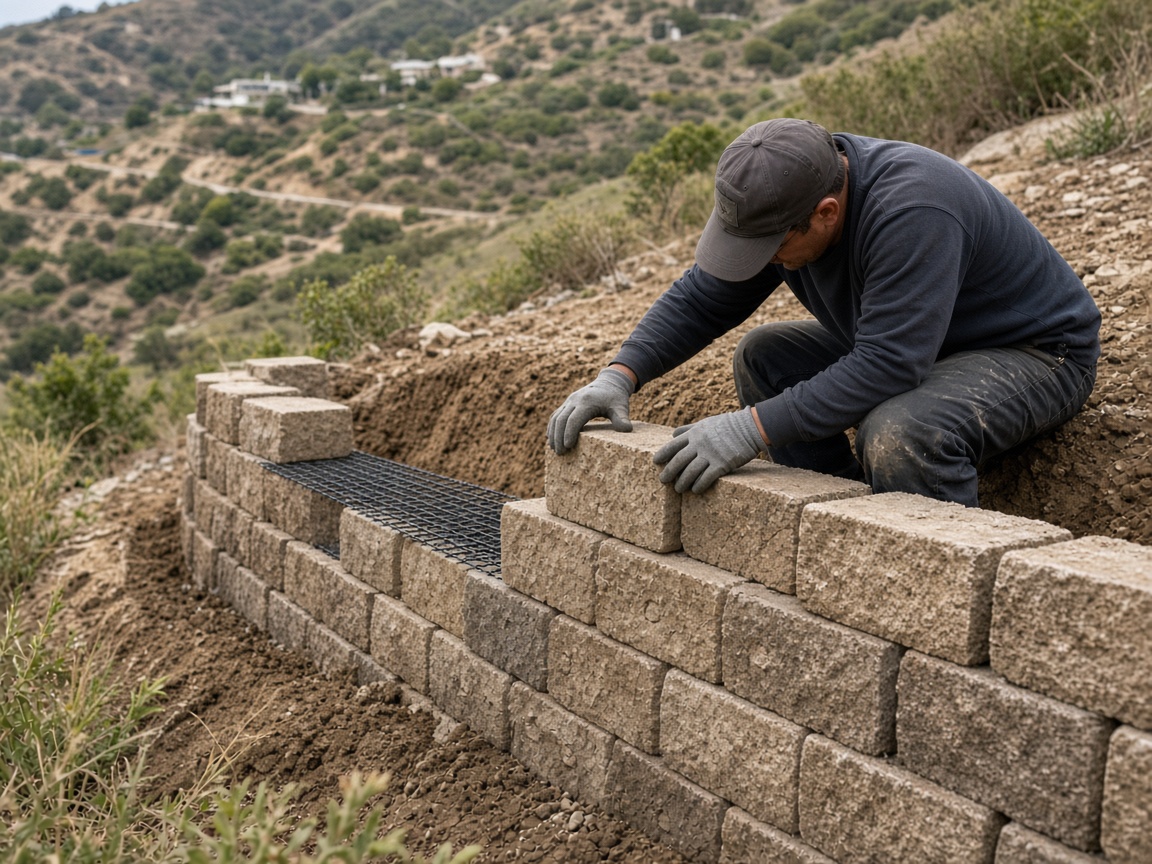
Segmental Retaining Walls San Jose
Interlocking segmental retaining wall systems (Allan Block, Versa-Lok) engineered for stability on hillside properties and terraced gardens.
What We Handle
- Interlocking segmental block systems (Allan Block, Versa-Lok)
- Geogrid-reinforced for walls of any height
- Manufacturer-certified engineering documentation
- Variety of block shapes and colors available
- Efficient installation for hillside terrace projects
Segmental retaining wall (SRW) systems are purpose-engineered interlocking block systems designed specifically for earth retention. Unlike simple concrete block walls or stone walls that rely primarily on mass, SRW systems use a combination of block geometry, block-to-block connection, and geogrid reinforcement to achieve structural performance across a wide range of heights and load conditions.
What Makes SRW Systems Different
Segmental retaining wall systems are backed by comprehensive engineering data from their manufacturers — design manuals, computer modeling tools, and certified calculation packages that engineering firms can use to produce stamped permit drawings relatively efficiently. This is a significant advantage for homeowners navigating San Jose's permit process, because the structural engineering work is largely pre-done by the block manufacturer's engineering department and validated through NCMA (National Concrete Masonry Association) testing protocols.
The block systems themselves are designed with precise geometry that ensures consistent setback (batter) per course, compatible connection mechanisms, and predictable interaction with geogrid reinforcement. This engineered consistency makes installation more precise and the structural results more predictable than custom-built stone or concrete walls.
Geogrid Reinforcement in SRW Systems
Geogrid is the element that enables segmental walls to reach heights that would be impossible with block mass alone. The geogrid — a polymer grid material with high tensile strength — is placed horizontally in the backfill behind the wall at intervals specified by the block system's engineering guidelines. The geogrid is connected to the back of the block units (through the block cores or using a mechanical connection) and extends back into the compacted soil fill a distance specified by engineering.
This geogrid layer, once covered with compacted fill, creates a soil-grid reinforced zone that functions as a gravity mass much larger and heavier than the wall itself. The blocks become the face of a reinforced soil structure, not the structure itself. With multiple geogrid layers, SRW systems can economically hold slopes to heights of 20 feet or more.
Selecting an SRW System for Your San Jose Project
The right segmental system depends on your wall height, available space behind the wall for geogrid embedment, aesthetic preferences, and local supplier availability. For walls under 4 feet, any of the major systems work without geogrid and the choice is primarily aesthetic. For walls over 4 feet, geogrid is required and the design is governed by block-system-specific engineering.
In the San Jose area, Allan Block, Versa-Lok, and Anchor systems are all widely available from regional landscape suppliers. We work with all three systems and can discuss which is best suited to your specific site and aesthetic goals during the initial consultation.
Common Questions
What is the difference between segmental retaining walls and standard retaining walls?
Segmental retaining wall systems are purpose-engineered products with certified structural documentation and consistent block geometry designed for earth retention. Standard retaining walls (poured concrete, CMU block, stone) are built to custom specifications each time. SRW systems offer more predictable performance and simpler permitting for residential heights.
How much space does geogrid need behind a segmental wall?
Geogrid embedment length is specified by the block system's engineering guidelines based on wall height and surcharge conditions. Typically, the geogrid needs to extend into the backfill at least 60-70% of the wall height. For a 6-foot wall, expect geogrid extending 4 to 5 feet into the slope. If site space is limited, the engineer may specify more frequent geogrid layers to reduce the required embedment length.
Can I use a segmental retaining wall on a steep hillside?
Yes, that is exactly what the systems are designed for. Steep hillside projects in Almaden Valley, Evergreen, and the San Jose foothills are among the most common segmental retaining wall applications. The engineering tools accommodate steep original ground angles and high soil pressure conditions.
Ready to move forward with your segmental walls project? San Jose Retaining Wall Co handles retaining wall work across San Jose and Santa Clara County. Call us or fill out the quote form and we'll be in touch quickly.
Get a Free Quote
Other Wall Services