
Gabion Retaining Walls San Jose
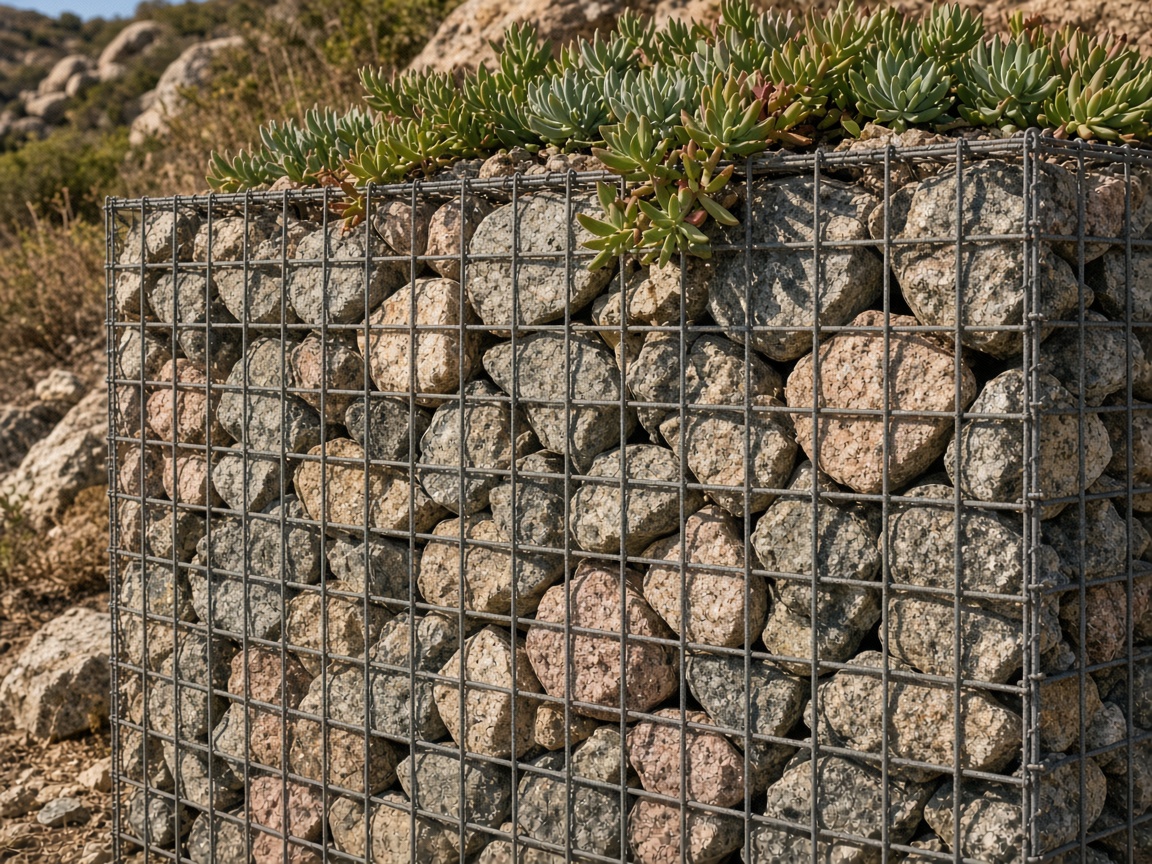
Wire-basket gabion walls filled with natural stone — an environmentally friendly option with excellent drainage and a rugged industrial aesthetic.
What We Handle
- Galvanized or PVC-coated wire mesh baskets
- Filled with natural stone — granite, river rock, or recycled concrete
- Excellent drainage — no hydrostatic pressure issues
- Flexible structure tolerates ground settlement without cracking
- Sustainable option using locally sourced fill material
Gabion walls — wire mesh baskets filled with natural stone — are one of the oldest engineered earth retention methods in use, originally developed for military fortifications and riverbank protection. In modern residential and commercial landscaping, gabion retaining walls have become popular for their drainage characteristics, structural flexibility, and distinctive industrial-natural aesthetic.
How Gabion Walls Are Constructed
Galvanized welded wire mesh cages are assembled on-site in standard sizes, typically 3 feet by 3 feet by 6 feet or similar configurations. Each cage is set in place, wired shut on one end, and then filled with stone through the open end before the final face is wired closed. The stone fill is placed by hand or with a small excavator bucket, with care taken to pack the face stones tightly for a clean appearance.
Baskets are stacked and wired together to form the wall, with each course typically set back slightly from the one below to create a stepped face. For tall walls, geotextile fabric is placed behind the gabion wall to prevent soil migration into the basket fill, and a gravel drainage layer is installed at the back of the wall for additional drainage capacity.
Structural and Drainage Advantages of Gabion Walls
Gabion walls have two significant engineering advantages over solid masonry walls. First, the gaps between the stone fill allow water to drain freely through the wall, eliminating the hydrostatic pressure that causes solid walls to fail. In San Jose's wet winters, this is a major benefit — a gabion wall is essentially self-draining.
Second, gabion walls are flexible structures. Unlike concrete or mortared masonry walls that crack when the ground moves, a gabion wall deforms slightly with ground settlement while maintaining its structural function. This makes them particularly appropriate for sites with soft or compressible soils, or areas where ground movement is expected.
Gabion Wall Aesthetics and Applications
The visual character of a gabion wall is strongly influenced by the stone fill selected. Rounded river cobbles create a smooth, organic appearance. Rough quarried granite has a more rugged, industrial look. The wire mesh itself, while functional, adds a contemporary geometric element that many designers use intentionally in modern landscape applications.
Gabion walls are well-suited to: stream bank and drainage channel retention; steep hillside applications where drainage is a significant concern; contemporary landscape designs where the industrial aesthetic is desired; and sites with difficult access where the lighter basket weight versus poured concrete or massive boulders is an advantage.
Common Questions
How long do gabion retaining walls last?
Galvanized gabion baskets typically have a lifespan of 30 to 60 years depending on soil conditions and water chemistry. PVC-coated mesh lasts longer in corrosive environments. The stone fill is essentially permanent — it does not degrade. Occasional basket repair or replacement is possible without rebuilding the entire wall.
What stone is used to fill gabion baskets?
Any hard, durable stone works. Common choices in the San Jose area include quarried granite, river cobble, and recycled concrete aggregate (which has the added benefit of being a sustainable use of demolition material). The stone should be sized to be larger than the basket mesh opening — typically 4 to 8 inch stone for standard mesh.
Do gabion walls need drainage behind them?
Because the stone fill is inherently porous, gabion walls have excellent self-draining characteristics. However, a geotextile fabric backing is recommended to prevent fine soil particles from migrating through the basket mesh into the stone fill, which would eventually clog the drainage. For high-water-table sites, a supplemental gravel drainage layer behind the baskets is also advisable.
Ready to move forward with your gabion walls project? San Jose Retaining Wall Co handles retaining wall work across San Jose and Santa Clara County. Call us or fill out the quote form and we'll be in touch quickly.
Get a Free Quote
Other Wall Services