
Retaining Wall Drainage San Jose
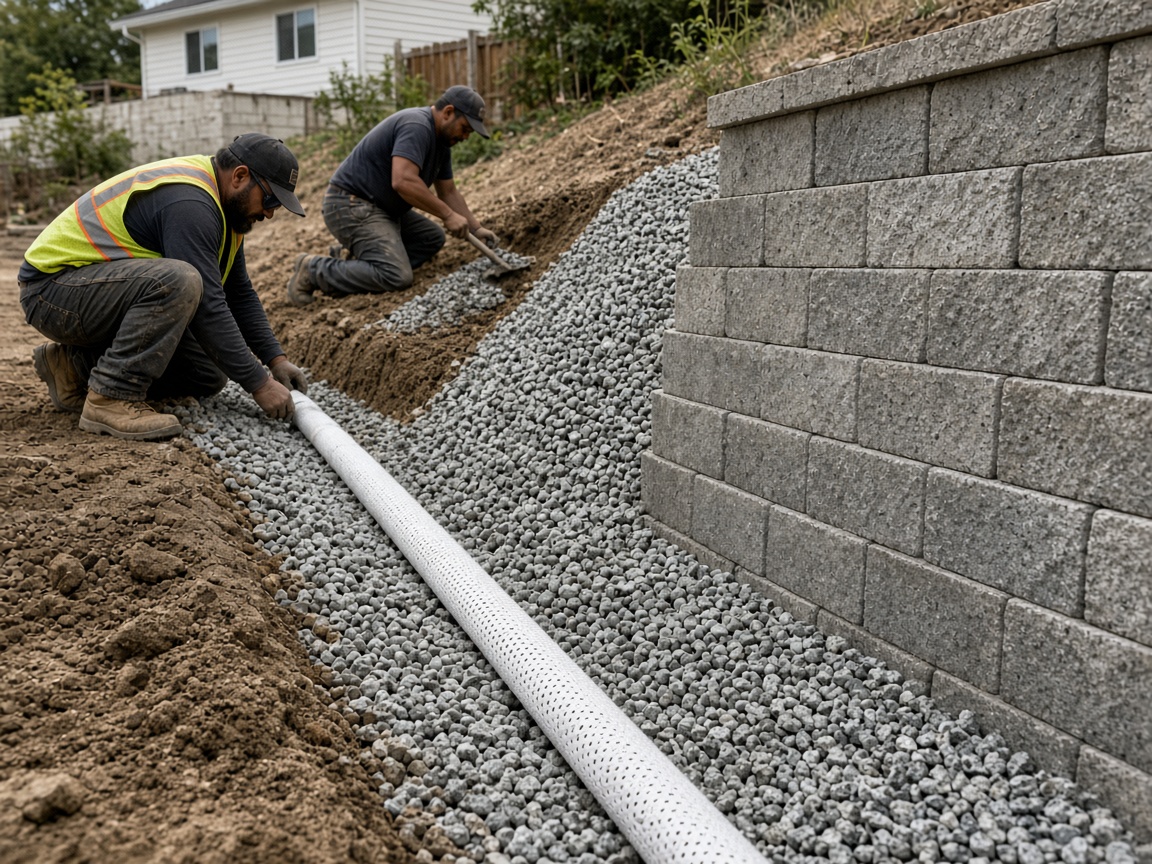
Proper drainage is what keeps retaining walls standing. We install French drains, weep holes, gravel backfill, and perforated pipe systems behind every wall we build.
What We Handle
- French drain installation behind new and existing walls
- Perforated pipe and gravel backfill systems
- Weep hole drilling in existing solid walls
- Surface drain and area drain installation
- Geotextile filter fabric to prevent long-term clogging
Water is what kills most retaining walls. Not age, not poor materials, not even inadequate block size — water. Specifically, hydrostatic pressure: the pressure of water held in saturated soil against the back face of a wall that cannot escape fast enough. Proper drainage design is not an optional add-on to a retaining wall project. It is the most important structural element of the entire system.
Why Drainage Is the Most Critical Part of Any Wall
Consider the forces involved. A cubic foot of saturated soil weighs approximately 130 pounds. A wall retaining 6 feet of saturated clay, fully saturated to the top, faces lateral forces that exceed what most homeowners intuitively expect from soil alone. That pressure is what causes walls to lean, crack, and eventually fall.
But water pressure is not constant — it accumulates during and after rain events and dissipates over days or weeks in well-drained soil. The drainage system's job is to intercept that water before it builds to dangerous pressure levels and route it safely away from the back of the wall. When it works correctly, the wall essentially never experiences full hydrostatic pressure. When it fails, the wall does.
Components of a Complete Retaining Wall Drainage System
A properly designed drainage system for a San Jose retaining wall includes several layers working together. The first layer is a coarse gravel zone directly behind the wall — typically 12 to 18 inches of clean 3/4-inch crushed stone, placed for the full height of the wall. This zone provides immediate drainage of water that infiltrates behind the wall, preventing any accumulation directly against the wall face.
The second component is a perforated drain pipe at the base of the gravel zone, running the full length of the wall and sloped at a minimum 1% grade to a daylight outlet. This pipe is the primary water removal mechanism — it captures water that has filtered through the gravel and carries it to a safe outlet away from the structure. The pipe is wrapped in filter fabric (or the gravel zone is separated from native soil by a geotextile fabric) to prevent fine soil particles from migrating into the gravel and reducing its drainage capacity over time.
For solid material walls (poured concrete, CMU, mortared stone), weep holes through the lower courses provide a secondary pressure relief valve. Typically 2-inch PVC pipe inserts through the wall face at 6 to 8 foot intervals, roughly 6 inches above the base of the wall, allow trapped water to escape before building to dangerous pressure levels.
Drainage Remediation for Existing Walls
For walls that were built without adequate drainage — unfortunately common in San Jose's older residential construction — remediation is possible and is usually far less expensive than full replacement if caught before structural damage becomes severe.
Drainage remediation approaches include: excavating behind the wall (or a section of it) to install gravel backfill and perforated drain pipe where none existed; drilling weep holes through the face of an existing solid wall to provide pressure relief; installing surface drains or area drains upslope to intercept runoff before it reaches the back of the wall; and in some cases, installing a drainage swale or berm to redirect surface water flow away from the wall's drainage catchment area.
Common Questions
How do I know if my retaining wall drainage is failing?
Key signs: water pooling against the base of the wall after rain events; dry weep holes during or immediately after heavy rain (they should be flowing); efflorescence (white mineral deposits) on the wall face; and progressive wall lean or bulging. If you see any of these, a drainage assessment is overdue.
Can I add drainage to an existing retaining wall?
Often yes. The approach depends on the wall type and the access available. For solid walls, weep holes can be drilled through the face. For block walls, drainage pipe can sometimes be added from above by probing down behind the blocks. For more comprehensive remediation, partial excavation behind the wall is usually necessary.
What is the outlet for a retaining wall drain pipe?
The perforated drain pipe should outlet to daylight — meaning it exits through the lower face of the wall or at the end of the wall where water can flow freely away from the structure. In San Jose, the outlet typically discharges to a landscaped area, a surface swale, or a connection to the property's storm drain system if one exists. Water should not discharge to a neighbor's property or to public right-of-way without an easement.
Ready to move forward with your drainage systems project? San Jose Retaining Wall Co handles retaining wall work across San Jose and Santa Clara County. Call us or fill out the quote form and we'll be in touch quickly.
Get a Free Quote
Other Wall Services