
Retaining Wall Repair San Jose
Leaning, cracked, or bowing walls repaired fast. We assess structural integrity, fix drainage failures, and restore walls to full holding strength.
What We Handle
- Structural assessment to determine repair vs. replace
- Wall pin and helical anchor installation for leaning walls
- Mortar joint repointing and crack injection
- Drainage remediation to address root cause of failure
- Block, stone, and concrete repair matching original material
Retaining walls do not fail overnight. The process is gradual — a slight tilt becomes a lean, small cracks widen over successive wet seasons, and drainage that was marginal from day one eventually clogs completely. By the time most homeowners call for help, the wall has been signaling distress for a year or more. Catching problems early can mean the difference between a repair and a full replacement.
Signs Your Wall Needs Professional Attention
A wall that is tilting or leaning forward is the most obvious sign. Even a few degrees of lean indicates that the wall is no longer in equilibrium with the soil pressure it is retaining. Left unaddressed, that lean accelerates — soil pressure is non-linear, and a wall at 5 degrees of lean is under significantly more stress than one at 2 degrees.
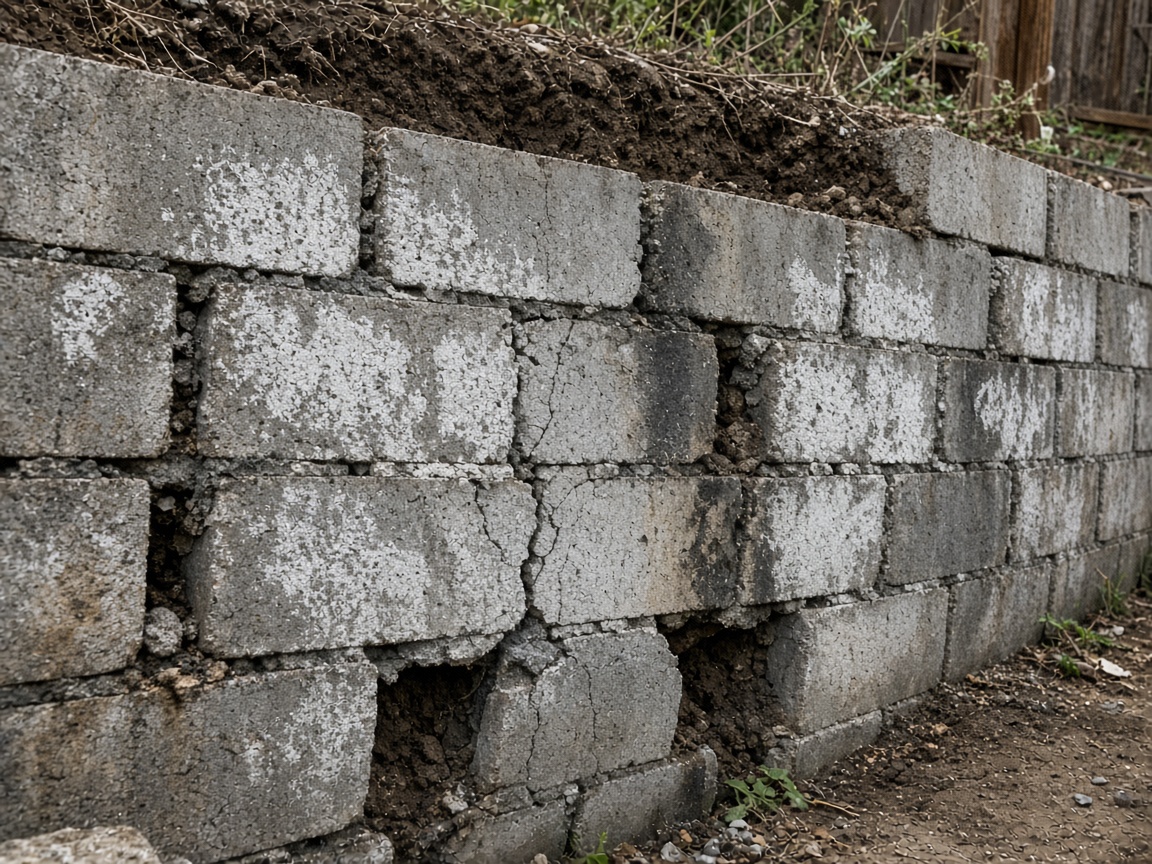
Cracks in the wall face can be aesthetic or structural depending on their orientation and size. Horizontal cracks in concrete or masonry are more concerning than vertical ones — horizontal cracks parallel to the base indicate the wall is bending under lateral soil pressure. Stair-step cracks in mortar joints often indicate differential settlement.
Efflorescence (white mineral deposits on the face of the wall) is a sign that water is moving through the wall material, suggesting drainage is not working. Standing water pooling against the base of the wall after rain is a clear drainage failure indicator.
Common Retaining Wall Repair Methods
The right repair depends entirely on what caused the problem. Treating symptoms without addressing the cause just delays the next failure.
For leaning walls, helical anchor systems or wall pins can be driven horizontally through the wall and anchored into the stable soil mass behind it. These anchors are tensioned to pull the wall back toward plumb and provide ongoing restraint against continued movement.
Drainage remediation is almost always part of a retaining wall repair, because drainage failure is almost always part of what caused the problem. This may mean excavating behind the wall to install proper gravel backfill and perforated drain pipe, drilling through the wall to add weep holes, or installing surface drainage upstream.
Mortar joint repointing restores the structural bond between masonry units and seals water entry points. Crack injection with epoxy or polyurethane grout can restore structural continuity in cracked concrete walls.
Repair or Replace: Making the Right Call
Some walls are worth saving, and some are not. A wall worth repairing is one where the structure is still fundamentally sound — the blocks or concrete are not deteriorated, the footing is stable, and the distress is primarily drainage-related. A wall that has tilted more than 3 to 4 inches, has significant structural cracking, has a failed or missing footing, or is built from materials that have reached end of life (severely rotted timber, badly spalled concrete block) is generally better replaced than repaired.
The economic calculus matters too. If a repair costs more than 50-60% of the replacement cost and the remaining life expectancy is short regardless, replacement wins. We give you an honest assessment during the site visit.
Common Questions
Can a leaning retaining wall be fixed without replacing it?
Often yes, depending on how far it has leaned and whether the footing is still sound. Helical anchors and wall pins can stabilize and partially correct a leaning wall. But walls that have moved significantly or have a compromised footing usually need replacement.
How do I know if my retaining wall drainage is failing?
Signs include pooling water against the wall base after rain, efflorescence on the wall face, weep holes that are not draining despite rainfall, and progressive leaning. The only way to confirm is a site assessment — we can often spot the issue without excavating.
How long does a retaining wall repair take?
Simple drainage repairs and anchor installations can be done in 1 to 2 days. More complex projects involving partial reconstruction and drainage system installation typically take 3 to 5 days.
Ready to move forward with your repair project? San Jose Retaining Wall Co handles retaining wall work across San Jose and Santa Clara County. Call us or fill out the quote form and we'll be in touch quickly.
Get a Free Quote
Other Wall Services